A medical director with an expired malpractice policy or a license from the wrong state is a shutdown risk. Regulators will not accept “we thought he was licensed” as a defense, and a plaintiff’s attorney will not accept it either. Most owners know they need a medical director, but few realize how thin that role gets when nobody checks it: a “paper” medical director who signs an agreement and never opens a chart satisfies no one, not your board, not your carrier, and not the patient in your treatment chair. Here is the exact list of medical director qualifications to verify before you sign anything, including how to structure the role if your model runs on a nurse practitioner backed by collaborating physician services.
Key Takeaways
- A medical director must clear five specific requirements, not just hold a license: active in-state licensure, aesthetic-specific malpractice coverage, real aesthetic experience, genuine availability, and a signed, state-compliant agreement. (Jump to section)
- Requirements shift by state, from Iowa’s mandated on-site hours to Arizona’s nurse practitioner-led model, so experience in one state does not guarantee compliance in another. (Jump to section)
- Six specific questions reveal whether a candidate provides real oversight or just a signature. (Jump to section)
What to Look for in a Medical Director
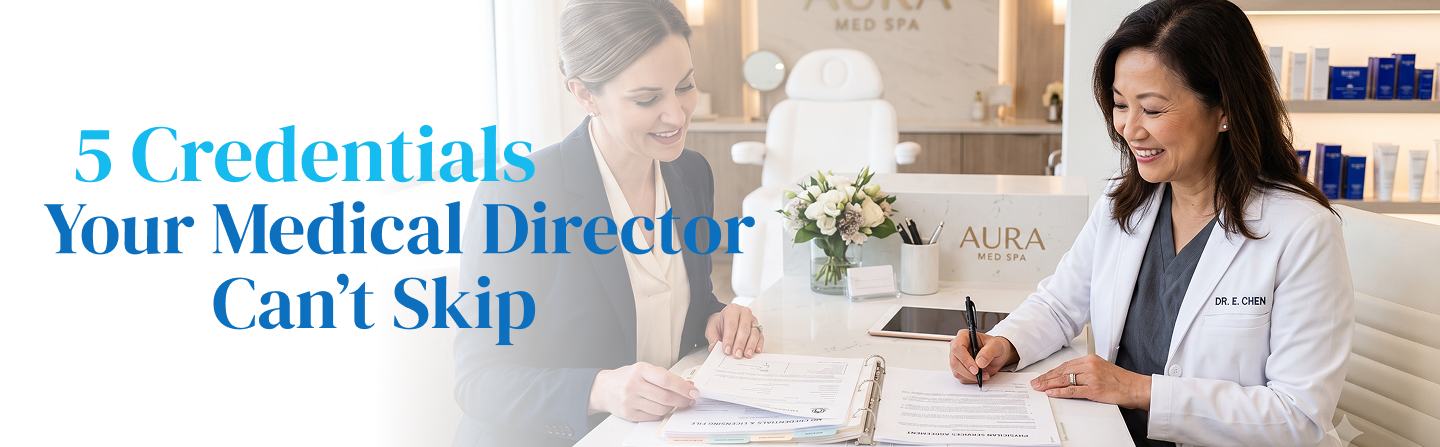
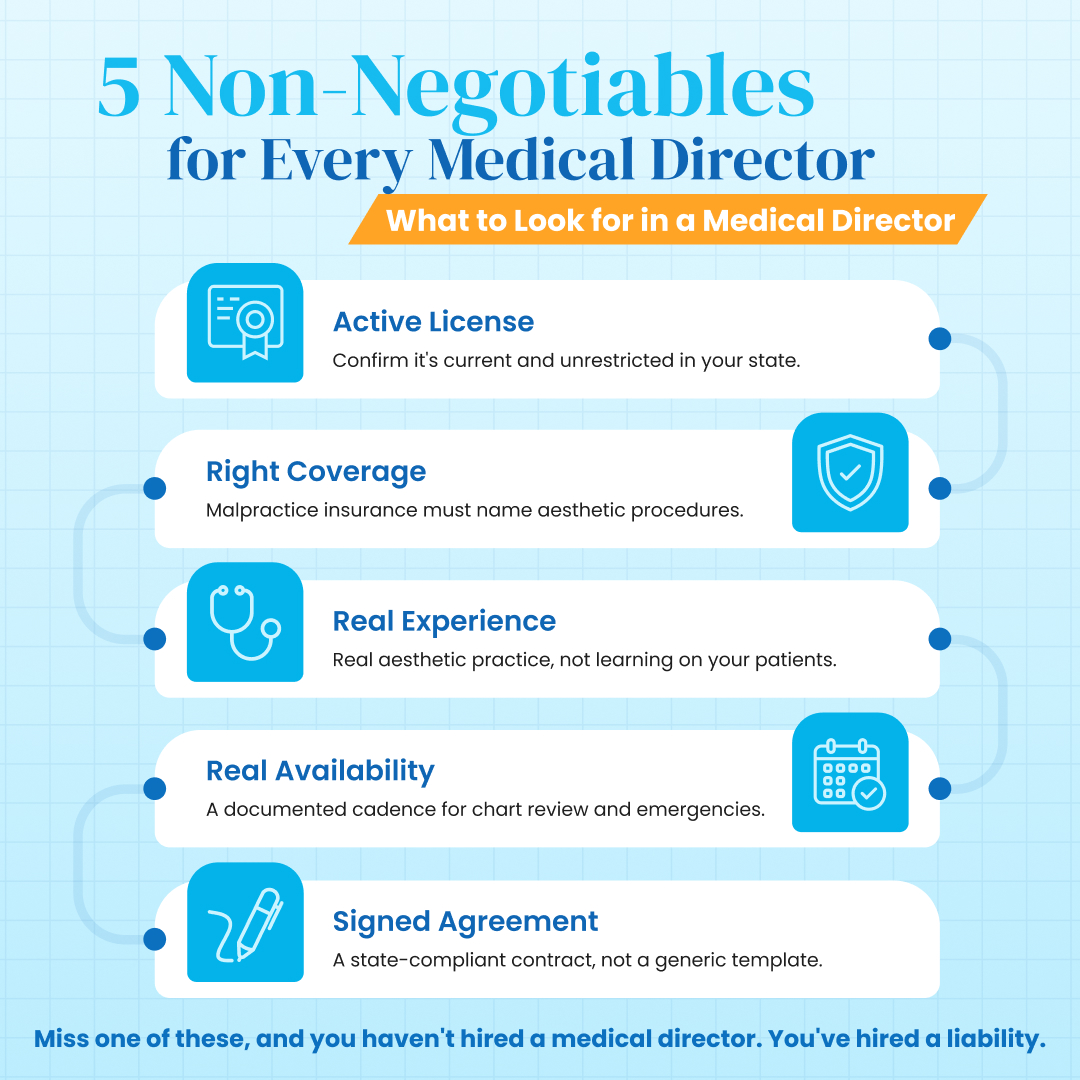
Before you look at a single resume, know what you are checking for. A credential on paper means nothing if the physician cannot back it up with real coverage, real experience, and real availability. These five requirements separate a medical director who protects your practice from one who becomes its biggest liability:
- Active, unrestricted medical license: The physician must hold a current license in the state where your med spa operates, with no suspensions, restrictions, or lapses on record.
- Aesthetic-specific malpractice coverage: The policy must explicitly name the procedures your med spa performs, not rely on general practice coverage that assumes it applies.
- Real aesthetic experience: The physician has actually worked in a med spa or aesthetic setting, not agreed to learn the specialty on your patients.
- Availability for chart review: The physician commits to a specific, documented cadence for reviewing charts, updating protocols, and answering emergencies.
- A signed, state-compliant agreement: The agreement defines the scope of supervision in writing and reflects your specific state’s requirements.
Each one is a pass/fail check. A candidate who is strong on four out of five is not a compromise. They are a liability with a résumé attached.
Active, Unrestricted Medical License in Your State
The physician must hold a current license in the state where your med spa physically operates, not in a neighboring state. The license cannot have been suspended, probated, or restricted at any point. An out-of-state license does not satisfy this requirement even if the physician is board-certified and highly experienced elsewhere. This requirement, along with the scope of supervision and chart review terms, should be spelled out in a medical director agreement before the physician ever sees a patient chart.
Verify this yourself through the Federation of State Medical Boards’ DocInfo database, which pulls licensure and disciplinary history directly from state medical boards. Do not accept a photocopy of a license card as proof. Cards do not show the current status, and a license can lapse or face action after the card is printed.
Malpractice Coverage That Explicitly Covers Aesthetic Procedures
General medical malpractice insurance does not automatically cover injectables, laser treatments, or other aesthetic procedures. Some policies exclude cosmetic work entirely, and others cap coverage at a level that will not hold up against a real claim. Ask for written confirmation from the carrier, not a verbal assurance from the physician, that the policy covers the specific procedures your med spa performs.
State-Specific Licensing Considerations
Medical director requirements are not uniform across state lines, and the differences go well beyond who holds the license. States vary in how much physical presence they require, whether nurse practitioners can independently fill the role, and what documentation a board will ask for during an inspection. The table below shows how far that variation stretches, and our medical director agreement template is built to reflect whichever model applies to you.
State | Medical Director Model | Key Requirement Beyond a Signed Agreement |
|---|
Florida | Physician-supervised | Board certification or eligibility in dermatology or plastic surgery for physicians supervising APRNs or PAs at satellite aesthetic locations. |
Iowa | Physician-supervised | Direct, on-site supervision for at least 4 hours each week, with the physician located within 60 miles of the delegated service site. |
Oklahoma | Physician-supervised | Physical availability before, during, and after procedures delegated to LPNs, estheticians, or other unlicensed staff. |
Arizona | NP-eligible | A nurse practitioner with full practice authority may serve as medical director; physician supervision is not required. |
Texas, California, New York, Illinois, Ohio | CPOM-restricted | Strict Corporate Practice of Medicine rules keep medical decisions under licensed clinicians regardless of who owns the business. |
Arizona sits at the opposite end of the spectrum. Physician supervision is not a requirement for med spas there, since nurse practitioners are afforded full independent scope of practice authority and may even assume the role of medical director. States with strict Corporate Practice of Medicine rules add another layer: in Texas, California, New York, Illinois, and Ohio, medical decisions must remain under the control of licensed clinicians regardless of who owns the business.
The takeaway is not that one state’s rules are strict and another’s are lax. It is that assuming your medical director’s home-state experience translates directly to your state, is how med spas end up out of compliance without realizing it.
How to Verify a Medical License Without a Middleman
A credentialing service is not required to confirm whether a physician’s license is real. Every state medical board publishes this information for free, and the federal database consolidates it across state lines. Run these five steps yourself before you sign anything:
- Search the database: Go to your state’s medical board website, or use the FSMB’s DocInfo tool for a national search.
- Look up the physician: Search by the physician’s full name or license number.
- Confirm active status: The license status must read active, not expired, suspended, or probationary.
- Check the disciplinary history: Review this section for any board actions, settlements, or pending complaints.
- Document what you found: Save a screenshot with the date visible, since verbal confirmation from the physician is not documentation.
States with Stricter Aesthetic Supervision Requirements
Supervision requirements generally fall into two categories. General supervision means the physician holds overall responsibility without needing to be physically present for every procedure. Direct or personal supervision requires the physician’s physical presence for specific treatments, typically the more invasive ones like certain injectables and energy-based devices.
States like Iowa and Oklahoma lean toward the stricter end for lower-licensed staff. Oklahoma allows more generalized supervision when services are delegated to a licensed RN. When services are delegated to LPNs, licensed estheticians, medical assistants, or other unlicensed personnel, the supervising physician must be physically available before, during, and after the procedure. If your med spa operates in one of these states, confirm your medical director understands the specific supervision tier each staff role requires.
Stop Gambling on an Underqualified Medical Director
Questions to Ask When Vetting a Medical Director
A resume tells you what a physician has done. It does not tell you what they will actually do once they hold the title, and that gap is where most bad hires happen. The answers to these six questions reveal whether a candidate will function as a real medical director or just a signature on a wall:
- How many med spas are you currently the medical director for? A physician spread across a dozen locations cannot provide real oversight at any of them.
- What is your process for reviewing charts, and how often do you do it? Vague answers here are the clearest red flag on this list.
- Do you carry malpractice coverage that names aesthetic procedures specifically? Ask for the carrier’s written confirmation, not a verbal yes.
- Are you willing to sign an agreement built for this state’s specific requirements? A generic template signals the physician has not done this before, or does not take it seriously.
- What is your availability for emergencies during business hours? Get a specific answer: a phone number, a response window, a backup contact.
- Have you had any board actions, complaints, or license restrictions in any state? Ask directly, then verify independently. Do not rely solely on the answer.
What to Listen For in Their Chart Review Answer
This single question separates an engaged medical director from a rent-a-license arrangement. A physician who does not know your state’s chart review requirements before you ask has likely never functioned as an active medical director anywhere. The strongest answers name a specific cadence, a specific documentation method, and a specific plan for flagging concerns back to your staff. Anything vaguer than that is worth a follow-up question, not a signature.
How Medical Director Co. Verifies Every Physician
Medical Director Co. runs every physician through the same verification process before placement. That includes license status confirmed directly through state medical board records, malpractice coverage reviewed for aesthetic-specific scope, and experience screened against actual med spa or aesthetic practice history. A state-compliant agreement is built into the placement, not left for you to draft separately. If your model relies on an NP-led team, MDCo can also structure collaborating physician services around it. Plans start at $799 per month with no setup fees, and MDCo places a compliant medical director in as little as 24 hours.
What ‘State-Compliant’ Means in the MDCo Process
Every agreement MDCo builds reflects the specific requirements of the state where your med spa operates, not a generic template adapted after the fact. That means the supervision terms, chart review cadence, and documentation standards are written to match what your state board actually expects, not what a template from a different state happened to include.
FAQ
What qualifications must a medical director have for a med spa?
At minimum, an active and unrestricted medical license in the state where the med spa operates, malpractice insurance that explicitly covers aesthetic procedures, real experience in aesthetic or med spa settings, and a signed agreement defining the scope of their supervision.
Do all states require the same medical director credentials?
Requirements vary significantly by state, from how much physical presence is required to whether a nurse practitioner can serve in the role at all. In states like Arizona, physician supervision is not a requirement for med spas, as nurse practitioners are afforded a full independent scope of practice authority, while other states require documented, in-person physician supervision on a set schedule.
How do I verify a medical director’s license?
Search the physician’s name or license number through your state medical board’s website or the FSMB’s DocInfo database, which consolidates licensure and disciplinary records nationally. Confirm the license is active and review the disciplinary history section before finalizing any agreement.
Can a nurse practitioner be a medical director of a med spa?
Most states reserve this role for a physician, with a narrow exception. States with full nurse practitioner practice authority, such as Arizona, allow it: the Board of Nursing has stated that nurse practitioners may serve as medical directors with the proper education, competency, and certification for the procedures under their supervision. Confirm your specific state’s rule before assuming either answer applies.
What happens if my medical director loses their license?
Your med spa can no longer legally perform or delegate any procedure that requires physician-level oversight until a qualified replacement is in place. This is not a grace-period situation. Continuing operations without an active, licensed medical director exposes the practice to board action, fines, and potential shutdown. The agreement with your medical director should specify what happens if their license is suspended or revoked, including notice requirements and a transition plan, and you should have a plan for immediate replacement rather than discovering the gap during an inspection.
Checking All Five Before You Sign
The five requirements that matter are an active in-state license, aesthetic-specific malpractice coverage, real aesthetic experience, genuine availability, and a signed, state-compliant agreement. Skip any one of them, and you are not hiring a medical director. You are hiring a liability with a signature, and Medical Director Co. can find you a compliant one in as little as 24 hours.
Get your med spa licensed the right way.