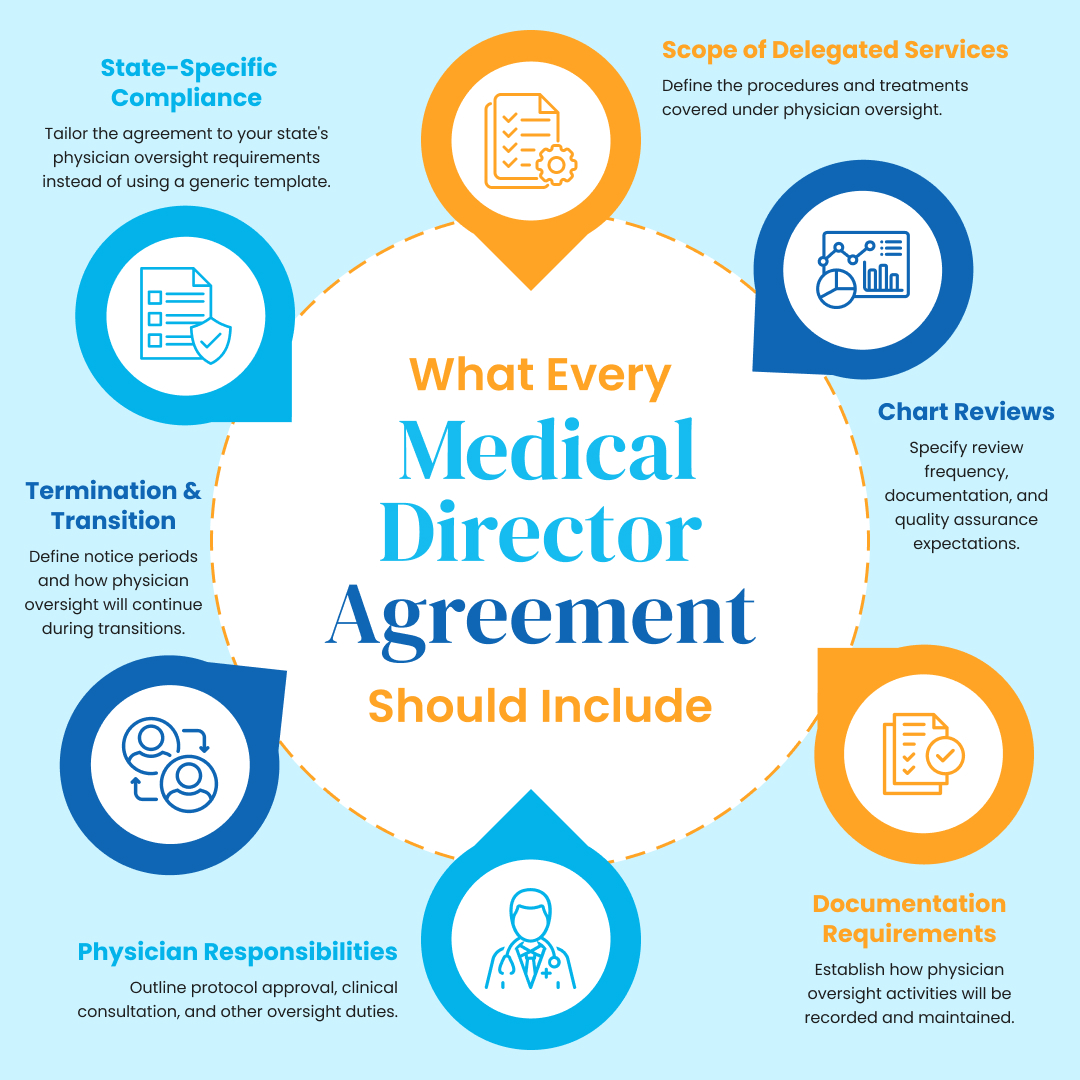
A medical director agreement should clearly define the physician’s oversight responsibilities, delegated services, documentation requirements, termination terms, and any state-specific obligations that apply to your practice. Because these requirements vary by state, a generic template may not provide the documentation needed to support compliance. Knowing what to look for before signing can help you avoid common compliance mistakes.
Key Takeaways
- A medical director agreement outlines the medical director’s responsibilities, the practice’s obligations, and the terms that govern the working relationship to support regulatory compliance. (Jump to Section)
- Every agreement should include clear, specific provisions. Key clauses typically address delegated services, chart review requirements, documentation standards, termination terms, and other physician oversight responsibilities required by state law. (Jump to Section)
- Generic agreement templates may not meet state-specific requirements. Physician oversight regulations vary across jurisdictions, making it important to use an agreement that reflects the laws and expectations where your med spa operates. (Jump to Section)
- Medical director agreements and collaborating physician agreements serve different purposes. A medical director agreement establishes physician oversight for the practice, while a collaborating physician agreement governs the relationship between a physician and a nurse practitioner in states that require collaboration. (Jump to Section)
- A state-compliant agreement helps build a stronger compliance foundation. Medical Director Co. provides attorney-reviewed, state-specific agreements with every physician placement, helping med spas establish clear expectations and support long-term compliance. (Jump to Section)
What Is a Medical Director Agreement?
A medical director agreement is a legal contract that establishes the relationship between a medical director and a med spa. It outlines the physician’s responsibilities, the services they will oversee, the expectations for physician involvement, and the obligations of both parties throughout the engagement. A well-drafted agreement also helps demonstrate that physician oversight has been formally established in accordance with applicable state requirements.
Although the specific provisions vary by jurisdiction, a medical director agreement typically addresses clinical oversight, delegated responsibilities, communication expectations, documentation requirements, compensation, liability, and the circumstances under which the agreement may be modified or terminated. Instead of serving as a simple administrative document, it creates the framework for how physician oversight will function within the practice.
For a closer look at the qualifications physicians should meet before serving in this role, read our guide to medical director qualifications.
Medical Director Agreement vs. Collaborative Practice Agreement: The Difference
A medical director agreement establishes the physician’s oversight responsibilities for a medical practice or med spa. Depending on state law, this may include approving treatment protocols, supervising delegated procedures, performing chart reviews, participating in quality assurance activities, remaining available for clinical consultation, and fulfilling other medical director responsibilities required by the jurisdiction.
While a collaborating physician agreement, on the other hand, often referred to as a collaborative practice agreement, governs the working relationship between a physician and an advanced practice provider, such as a nurse practitioner. These agreements define how the physician collaborates with the provider, including supervision, consultation, prescriptive authority, and other responsibilities required under state law.
Some med spas require only a medical director agreement, while others may also need a collaborating physician agreement depending on their staffing model and state regulations. Understanding which agreement applies to your practice is an important part of building a compliant physician oversight structure.
Get a Medical Director Agreement You Can Trust
What a Compliant Medical Director Agreement Must Include
A compliant medical director agreement should clearly define how physician oversight will be provided within your practice. While the required provisions vary by state, several core elements appear in most well-drafted agreements. These clauses help establish expectations, clarify responsibilities, and demonstrate that physician oversight extends beyond simply lending a medical license.
Scope of Delegated Services: Be Specific
The agreement should clearly identify the procedures and clinical services the medical director is responsible for overseeing. Vague language such as “provide medical oversight” often leaves too much room for interpretation and may not adequately reflect the physician’s actual responsibilities.
Depending on your state’s requirements, the agreement may address:
- Treatments covered under physician oversight: Specify which aesthetic procedures, medications, or clinical services fall under the medical director’s supervision.
- Delegated medical procedures: Define which services may be delegated to qualified providers and the level of physician involvement required.
- Protocol development and approval: Identify the physician’s role in establishing, reviewing, and updating treatment protocols.
- Clinical consultation: Explain when the physician must be available to answer clinical questions or assist with patient care decisions.
Clearly defining these responsibilities helps ensure both the physician and the practice understand how oversight will be carried out.
Chart Review Frequency and Documentation Requirements
If your state requires chart reviews, the agreement should explain how frequently they will occur and how they will be documented. Do not rely on informal arrangements, the agreement should establish a consistent review process that aligns with applicable regulations.
Common provisions may include:
- Chart review schedule: Specify whether reviews occur monthly, quarterly, or according to another state-required timeframe.
- Documentation standards: Describe how completed reviews, recommendations, and corrective actions will be recorded.
- Quality assurance activities: Outline the physician’s participation in ongoing compliance reviews, audits, or performance improvement initiatives when required.
- Record retention: Clarify how oversight documentation will be maintained to support regulatory inspections or audits.
Well-defined documentation procedures create a clear record of physician involvement, support consistent clinical oversight, and help demonstrate compliance during regulatory reviews or audits.
Termination Conditions and Transition Language
Every medical director agreement should include provisions explaining how the relationship may end and what happens if either party terminates the agreement. Without a transition plan, a practice could unexpectedly lose physician oversight, creating operational and compliance challenges.
A comprehensive agreement should address:
- Notice requirements: Specify how much advance notice must be provided before terminating the agreement.
- Transition responsibilities: Define how physician oversight will continue while a replacement medical director is identified, when permitted by state law.
- Transfer of responsibilities: Clarify how protocols, records, and ongoing oversight activities will be transferred during the transition.
- Compliance obligations: Ensure both parties understand their responsibilities following termination, including any documentation or regulatory requirements.
Addressing these scenarios in advance helps reduce operational disruption, supports continuity of patient care, and provides a clear plan for maintaining physician oversight if the relationship ends.
Sample Clause Walkthrough
The exact wording will vary based on state law, but a medical director agreement should clearly define each party’s responsibilities. For example:
Agreement Section | Example Purpose |
|---|
Scope of Services | Identifies the procedures, treatments, and clinical activities the medical director oversees. |
Physician Responsibilities | Defines oversight duties such as protocol approval, chart reviews, consultations, and quality assurance activities. |
Practice Responsibilities | Explains the med spa’s obligations, including maintaining records, following approved protocols, and notifying the physician of reportable events. |
Term and Termination | Establishes the agreement’s duration, renewal process, notice periods, and transition procedures. |
Compliance With State Law | States that both parties will comply with all applicable state regulations governing physician oversight. |
Instead of depending on broad or generic language, every clause should accurately reflect how physician oversight will function within your practice. Clear, state-specific provisions help establish expectations, support regulatory compliance, and reduce the risk of misunderstandings throughout the physician relationship.
State-Specific Agreement Requirements
A medical director agreement should reflect the laws of the state where your med spa operates. Physician oversight requirements differ across the country, meaning an agreement that satisfies one state’s regulations may not meet another’s. Using documentation that is tailored to your state’s requirements helps ensure physician responsibilities, delegation, and oversight expectations are properly addressed.
Why a Generic Template Is a Compliance Risk
Generic agreement templates are often designed to work across multiple industries or jurisdictions. While they may include standard contract language, they frequently omit state-specific physician oversight requirements that are critical for med spas.
A state-compliant agreement may need to account for requirements such as:
- Physician oversight responsibilities: Some states require onsite visits, protocol approval, quality assurance activities, or physician availability beyond periodic chart reviews.
- Delegation requirements: States vary in which procedures may be delegated, who may perform them, and how physician supervision must be documented.
- Documentation and recordkeeping: Certain jurisdictions specify how physician oversight activities, chart reviews, and clinical consultations should be recorded.
- Collaborative practice requirements: If your practice employs nurse practitioners in a state requiring physician collaboration, a separate collaborating physician agreement may also be necessary.
- Regulatory updates: Physician oversight rules can change over time. Agreements should be reviewed periodically to reflect current state requirements than relying on outdated templates.
Because physician oversight requirements vary significantly, a one-size-fits-all agreement can leave important compliance gaps. Reviewing the agreement against your state’s regulations before signing helps ensure it accurately reflects the physician’s responsibilities and your practice’s operational needs.
Build Your Med Spa on a Strong Compliance Foundation
How Medical Director Co. Provides a State-Compliant Agreement with Every Placement
Medical Director Co. provides more than physician placement. Every placement includes a medical director agreement that is reviewed to reflect the oversight requirements applicable to your practice and state. Instead of relying on a generic template, the agreement is designed to establish clear physician responsibilities, support regulatory compliance, and provide a solid foundation for the working relationship.
What Medical Director Co.’s Agreement Review Process Looks Like
Every physician placement includes an attorney-reviewed medical director agreement tailored to your practice and the state where you operate. Before the agreement is finalized, Medical Director Co. reviews your services, staffing model, and physician oversight requirements to help ensure the documentation reflects your compliance needs.
The process includes:
- Understanding your practice: Information about your location, services, ownership structure, and staffing model helps determine the type of physician oversight required.
- Matching with a qualified physician: Medical Director Co. places physicians who are licensed in your state and whose qualifications align with your practice’s compliance needs.
- Preparing a state-compliant agreement: Each agreement is reviewed to reflect the physician’s oversight responsibilities, delegated services, and other applicable requirements.
- Supporting ongoing compliance: As your practice grows or regulations change, Medical Director Co, can help ensure your physician relationship and documentation continue to support your compliance obligations.
This review process helps ensure the agreement accurately reflects your physician relationship and provides documentation that supports your practice’s compliance requirements.
Get Your Med Spa Licensed the Right Way
FAQ
What is a medical director agreement?
A medical director agreement is a legal contract that outlines the relationship between a medical director and a med spa. It defines the physician’s oversight responsibilities, the services covered under the agreement, each party’s obligations, and other terms that govern the professional relationship.
What must a medical director agreement include?
While requirements vary by state, most agreements include the physician’s scope of responsibilities, delegated services, chart review expectations, documentation requirements, compensation, liability provisions, and termination terms. The agreement should also reflect any state-specific physician oversight requirements that apply to the practice.
Is a medical director agreement the same as a collaborating physician agreement?
A medical director agreement establishes the physician’s oversight responsibilities for a med spa, while a collaborating physician agreement governs the working relationship between a physician and a nurse practitioner in states that require physician collaboration. Some practices may require both agreements depending on their staffing model and state regulations.
Can I use a template for a medical director agreement?
A generic template may not address your state’s physician oversight requirements or your practice’s specific operations. Before using any template, it should be reviewed and customized to reflect the applicable regulations and the responsibilities expected of both the medical director and the practice.
How often should a medical director agreement be updated?
The agreement should be reviewed whenever there are significant changes to your services, staffing model, physician relationship, or applicable state regulations. Even if no major changes occur, periodic reviews help ensure the agreement continues to reflect current compliance requirements.
Get Your Medical Director Agreement Right
A medical director agreement does more than formalize a physician relationship. It establishes how physician oversight will be carried out, clarifies the responsibilities of both parties, and helps support compliance with applicable state requirements. Because physician oversight laws vary across jurisdictions, relying on a generic agreement can create unnecessary compliance risks.
Medical Director Co. helps med spa owners build compliant physician relationships by providing qualified medical director placements along with state-compliant, attorney-reviewed agreements. By starting with the right documentation, your practice can establish clear expectations, support ongoing compliance, and operate with greater confidence.
Start With a State-Compliant Agreement